Racing Line TV and the Rise of Mindanao Motorsports
DCRA Motorsports Media Feature · Aug 14, 2026
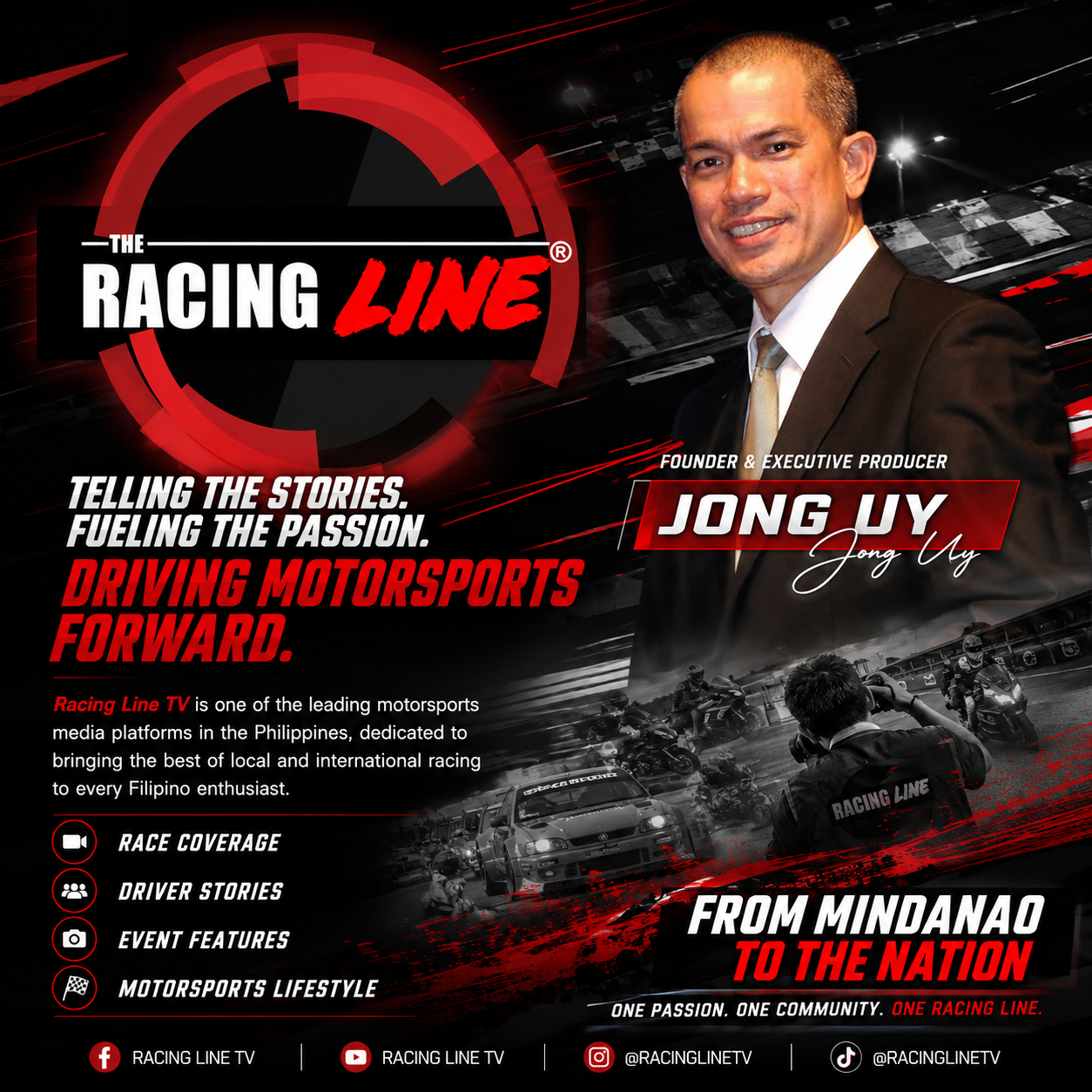
From telling the stories of Mindanao racers to witnessing a new era with a permanent circuit.
Before Mindanao had a permanent circuit to call home, the passion for motorsports was already here.
There were drivers building cars in their garages, riders traveling from city to city to compete, mechanics spending nights preparing machines, clubs bringing communities together, organizers creating races wherever suitable venues could be found, and fans standing beside temporary courses just to experience motorsports.
And for more than two decades, one of the names consistently helping put those stories in front of an audience has been The Racing Line TV.
Created in April 2005 by Jonathan George "Jong" Uy, The Racing Line developed with a distinctly regional mission: showcase the drivers, riders, mechanics and motorsports communities that often received far less national exposure than their passion deserved. Racing Line describes itself as the first and only regional motoring television show airing in the Visayas and Mindanao, with programming that has also reached Metro Manila and other parts of the Philippines.
Its mission was never simply to point cameras at fast cars and motorcycles.
It was about giving homegrown motorsports talent a stage.
A MEDIA PLATFORM THAT GREW WITH THE SOUTH
The story of Racing Line TV is closely connected to the story of motorsports in Mindanao.
Over the years, Racing Line did not only document motorsports. It also became involved in organizing and developing racing activities.
As early as the 2000s, Racing Line was helping create opportunities for racers in the region. By 2014, its regional autocross championship in Davao was drawing competitors from Davao, Cotabato, General Santos, Iligan, Cagayan de Oro and Marbel, with the competition designed to determine Davao's top driver and the Mindanao Driver of the Year.
That matters.
Because regional motorsports cannot grow on talent alone.
It needs organizers.
It needs venues.
It needs sponsors.
It needs mechanics and teams.
It needs championships that give racers something to pursue.
And it needs media that makes those racers visible.
Racing Line became part of that ecosystem.
Its reach eventually extended beyond Mindanao into cities including Cebu, Iloilo and Bacolod, helping connect motorsports communities across the Visayas and Mindanao.
In 2016, Racing Line also worked with InsideRACING on the Super Series Nationwide Championships, a seven-leg competition designed to bring racers from Luzon, Visayas and Mindanao into a national series. Jong Uy served as one of the race chairmen.
That regional-to-national connection is an important part of Racing Line's legacy.
It helped show that motorsports talent did not belong to only one part of the Philippines.
There were racers in the South ready to compete.
CREATING PLACES TO START
Racing Line's contribution was not limited to professional or established racers.
Jong Uy also pushed for accessible entry points into motorsports.
In Davao, Racing Line developed karting activities intended to introduce ordinary enthusiasts, families and young people to driving in a controlled environment. Uy emphasized responsible driving and described karting as an accessible way for people to begin learning motorsports.
The concept later expanded.
Racing Line karting operations appeared in Davao, Cagayan de Oro, Cebu, General Santos and Tagum, while its larger Davao Motorsports Arena combined karting, racing simulators and motorsports-oriented entertainment.
The philosophy was simple but important:
Give people somewhere to begin.
A child experiencing a kart for the first time could someday become a racer.
A young enthusiast watching a local championship could eventually build a competition car.
A street rider exposed to organized racing could discover that the real challenge is not racing another person on a public highway, but learning braking points, racing lines, consistency and discipline on a proper course.
This is how motorsports culture grows.
KEEPING MINDANAO RACERS VISIBLE
Through television, race coverage and later digital platforms, Racing Line continued putting regional motorsports in front of audiences.
Its own stated mission is to improve the motoring industry by showcasing homegrown drivers, riders and mechanics, giving them exposure and helping them develop through motorsports racing.
That mission remains visible today.
Racing Line continues producing motorsports programming and live discussions, including coverage of regional events in Davao and other parts of the country. Its Regional Underbone Grand Prix has also provided organized racetrack competition for riders from the Visayas and Mindanao.
Twenty years after its creation, the platform continues telling many of the same kinds of stories it was originally built to tell:
The local racer.
The regional champion.
The mechanic behind the machine.
The club keeping the community alive.
The young driver trying to move to the next level.
THE PROBLEM MINDANAO ALWAYS FACED
There was, however, one limitation that media coverage and passionate organizers alone could never completely solve:
Mindanao needed more permanent motorsports infrastructure.
In a 2016 profile, Jong Uy specifically identified the lack of facilities and racetracks as an obstacle to motorsports development and expressed the belief that having a proper racetrack would encourage further growth.
That observation is especially meaningful today.
Because years later, there is now a circuit in Davao where another chapter of that story can begin.
RACING LINE TV VISITS DAVAO CIRCUIT
Davao Circuit Riding Academy was honored to welcome Jonathan George "Jong" Uy — Creator, Founder, Executive Producer and Host of The Racing Line TV — to visit and observe the circuit.
For DCRA, this was more than an ordinary visit.
There is something meaningful about welcoming someone who spent decades helping document and develop regional motorsports to a facility representing what many enthusiasts in Mindanao had wanted for years:
a dedicated place to drive, ride, practice, train and compete.
The racers existed before the circuit.
The clubs existed before the circuit.
The builders existed before the circuit.
The organizers existed before the circuit.
The media existed before the circuit.
The passion was already here.
Now, there is another place where all of those pieces can come together.
A CIRCUIT FOR THE COMMUNITY
Davao Circuit does not want to become a racetrack belonging to only one organization, one championship, one club or one discipline.
We want it to become a home for motorsports.
To every racing team — welcome.
To every driver — welcome.
To every motorcycle rider — welcome.
To every car and motorcycle club — welcome.
To every organizer — welcome.
To every mechanic, tuner and builder — welcome.
To every photographer, videographer and motorsports media organization — welcome.
To every enthusiast from Davao, Tagum, General Santos, Cagayan de Oro, Cotabato, Bukidnon and communities throughout Mindanao — welcome.
And to our fellow motorsports communities from Cebu, Bacolod, Iloilo and across the Visayas — you are welcome here too.
Bring your team.
Bring your machine.
Organize your track day.
Put in your seat time.
Learn the racing line.
Test your setup.
Improve your driving.
Develop your riders.
Create championships.
Tell stories.
Meet other communities.
And enjoy motorsports where it belongs — in a controlled circuit environment.
FROM STREET ENTHUSIASTS TO CIRCUIT RACERS
This is one of the biggest opportunities a permanent circuit can create.
Not everyone entering Davao Circuit needs to arrive as a professional racer.
Some will arrive simply because they love cars.
Some will arrive because they love motorcycles.
Some may have spent years modifying their machines without ever experiencing a circuit.
Others may have grown up watching races covered by Racing Line TV.
The racetrack gives those enthusiasts another direction.
Instead of asking, "How fast is my car on the street?"
They can ask:
"How good can I become as a driver?"
Instead of racing between traffic, they can learn braking zones.
Instead of chasing another motorcycle on a highway, they can learn proper racing lines.
Instead of measuring courage through unnecessary risk, they can measure improvement with lap times.
That transformation — from enthusiast to trained circuit driver or rider — can become one of the most important developments for motorsports culture in Mindanao.
THE NEXT GENERATION OF MINDANAO MOTORSPORTS
Imagine what the next decade could look like.
A young driver from Tagum gets his first track experience at Davao Circuit.
A rider from General Santos begins training regularly.
A team from Cagayan de Oro travels to Davao for a championship.
Drivers from Cebu cross over for a major circuit event.
Local mechanics develop increasingly competitive cars.
Young racers begin with karting and eventually progress into full-sized competition.
Regional championships become stronger.
Sponsors see a growing audience.
Livestreams allow thousands of people to watch.
Media organizations tell the stories behind the competitors.
And eventually, racers developed in Mindanao and the Visayas compete successfully on bigger national and international stages.
That ecosystem cannot be built by DCRA alone.
It cannot be built by Racing Line alone.
It cannot be built by one organizer, one sponsor or one racing team.
It takes an entire community.
FROM DOCUMENTING THE DREAM TO SEEING THE CIRCUIT
That is why the visit of Racing Line TV carries significance.
Racing Line was already telling Mindanao's motorsports stories when the region was still searching for more places to race.
It covered racers.
It organized competitions.
It helped create opportunities.
It introduced people to karting.
It connected regional racers with national competition.
It kept cameras pointed toward talents that deserved to be seen.
And now, more than two decades after Racing Line TV was created in 2005, Mindanao's motorsports story continues with something previous generations repeatedly hoped to see:
a dedicated circuit closer to home.
There is still a long road ahead.
Davao Circuit will continue developing.
Regional championships need to grow.
Safety standards must continue improving.
Drivers and riders need more training.
Organizers need support.
Sponsors need reasons to invest.
And racers need opportunities to progress.
But the foundation is becoming stronger.
ONE COMMUNITY, A NEW CHAPTER
To Sir Jong Uy and The Racing Line TV, thank you for visiting Davao Circuit and seeing what is beginning to take shape.
Thank you for the years spent giving regional racers a voice.
Thank you for documenting the victories, rivalries, machines, personalities and communities that helped keep motorsports alive in Mindanao and the Visayas.
And to every driver, rider, team, club, organizer, builder and motorsports enthusiast reading this:
The circuit is here.
Come experience it.
Come practice.
Come organize.
Come compete.
Come create.
Come enjoy it.
Because this next chapter does not belong to one organization.
It belongs to the entire motorsports community.
The talent was already here.
The machines were already here.
The stories were already here.
The passion was always here.
Now, we have another place to bring all of it together.
WELCOME TO DAVAO CIRCUIT.
WELCOME TO A NEW CHAPTER FOR MINDANAO AND VISAYAS MOTORSPORTS. 🏁